Monday, June 19, 2006

O Branco, Brazil

O Branco (The Color White)
Directed by: Angela Pires, Liliana Sulzbach, Brazil, 2000, 22 mins.
Source: www.atomfilms.com/af/content/o_branco

The film opens with a shot of a burning sun. The shadowed figures of a man and boy walk through a field while a guitar plays in the background.The son asks, “Daddy, what color is the sun?” to which the father replies, “It depends on the hour.” He takes Fredi’s hand and traces a big circle in the air, explaining that the sun changes color during the day. Fredi says, “I prefer it white,” before adding, “I don’t like it when it gets dark” as his father places a stone in his hand. As they throw rocks towards the sun, his father says he understands this fear and replies, “It’s symbolic.” He then describes symbolism. They hug as Fredi’s father explains,“When I hug you really tight, which means I will be with you forever.”

Suddenly the sky darkens and we cut to an older Fredi getting dressed in a white bathroom. A narrator’s voice informs us that it is Saturday and that Fredi, who lives with his seamstress mother, always knows the days by “color.” Fredi is blind and spends almost all of his time inside, with the exception of trips to the market and Saturday afternoons at a park.

This Saturday, his mother leaves him on a park bench while she makes a phone call to “Alice.” She warns Fredi, “Don’t talk to anyone, they’ll steal everything, even your glasses.” A girl asks him to hold her ice cream cone while she ties her shoe. He drops it; she gets mad, wondering aloud, “there are some really bad people in this world.” Fredi stares straight ahead and mumbles, “sorry.” Claudia suddenly realizes he’s blind (signaled by the background sound of a few individual piano notes) and apologizes, but is soon called away. Fredi is left alone, swallowing away his nervousness.

Back at home, life is the same. Fredi continues his lonely routine and somber music plays as scenes virtually identical to the earlier weekday scenes fade into one another.

The next Saturday Caludia brings Fredi to swings on the river-side of the park and asks, “If you could see, what would you want to see the most?” He replies, “Branco” and explains, “It’s symbolic.” Fredi’s mother is angry when she finds him and drags him away.

On the following Saturday, Fredi adds a spray of cologne to his dressing routine, but is dismayed when his mother informs him, “No park for some time.” It is unclear whether this is because of some falling out with “Alice” or if she wants to shield him from Claudia and the outside world. Fredi leaves the house by himself, for presumably the first time ever. With his cane ,he makes his way to the bus, but he gets off at the wrong stop. Fredi gets lost and bumps into people. He is overwhelmed by cars beeping at him and visibly frustrated when he walks into side of building. He even walks down a thin road island that divides a very high-traffic urban road. Suddenly, he begins to take the arms of strangers and they help him cross streets until he finally reaches the park and meets Claudia. They spend the afternoon together and while they sit on a bench at sunset and cast stones into the air, Fredi reveals, “I feel as if I could see it.” He then asks what color the sun is and Claudia echoes his father’s words from the opening scene, describing the changing sun. The last image is a shot from behind. They sit with their backs to the cameras, in shadows under a red sun.

I was interested in this movie because it won a slew of awards including: Best Short Film, Rio de Janeiro International Film Festival 2000; Best Latin American and Caribbean Film - Divercine, Uruguay, 2001; Best Short Film, Biarritz Latin American Film Festival, France, 2001. This film works on a universal level because it explores the cyclical nature of life (implied loss of father), literal and figurative blindness and reliance on other people. The opening and ending scenes are both artistically beautiful and offer simple, but sweet insights, such as the idea of feeling (emotions like love in the present/love in the past) vs. seeing. There is great use of light vs. dark motifs throughout and the music relfects the emotional changes throughout the film well. One of the best understated moments was watching Fredi let strangers help him walk through the city.The actor who plays Fredi really does an excellent job.

Die Zwoelfte Stunde(Eine Nacht des Grauens) (The Twelfth Hour or Night of Horror)

DIE ZWOELFTE STUNDE (Eine Nacht des Grauens)
Keri Collins
Wales, 2004, 7:00

http://www.bbc.co.uk/dna/filmnetwork/A3743804

Despite the title, Die Zwoelfte Stunde is actually a British film. It begins as a typical black and white silent film reminiscent of the early years of film making. Raymond is an adolescent boy who has made up his mind, despite warnings, to go to the haunted castle and confront whatever he may find there. It is soon evident that this is not your ordinary silent film, but rather a twist on a classic form done completely with British humor. The dialogue screen goes back and forth between Raymond and one of the towns people arguing whether or not there exists true evil in castle. Raymond's repeated argument is "Not!"

Finally Raymond sets off for the castle only to be immediately confronted by a creepy vampire with extremely long fingers who stalks down the hall in true horror-movie fashion. When Raymond confronts him, the vampire, Nosferatu, offers Raymond a cup of tea. The dialogue screen tells us that Nosferatu is adding poison to... poison him, but Nosferatu is upset when Raymond asks for milk in his tea, and the poison is not imbibed.

Cut to the angry villagers who declare that they must save Raymond by killing the vampire! One villager points out that perhaps they could resolve the argument peacefully, there's a moment of contemplation, followed by shouts of "Kill him!"

Nosferatu shows Raymond out of the castle since it's getting dark and he'll be going out soon. When they leave, the angry villagers run up the hill and stab at Nosferatu with pitchforks and other agrarian tools, except to no avail, since Nosferatu creeps out of the pile and makes himself disappear. The villagers think they have saved the day and retreat back down to the village. Raymond shrugs, somewhat satisfied with his day.

I chose this film because of how typical the humor is to the dry British humor that is so well known. There was definitely a Monty Python feel to this short and I found myself laughing out loud, despite the fact that I was watching a b/w silent film.

Collins plays with the form and uses it in the comedy. It's unexpected and quite funny to have the boy and the older man arguing back and forth on dialogue screens and what they're saying is very much modern language. Also, there is a part when Raymond asks Nosferatu a question and Nosferatu is seen giving a long and quite animated response, only to have the dialogue screen pop up with "Na." I also felt the play on the "angry villagers" was incredibly funny, especially when the on man asks if they can resolve things peacefully--hysterical!

Also in the form of silent films is the music--it's reminiscent of the music we heard in the silent film we watched the first week of class. The music follows the action and adds to the mood, also indicates urgency, stunts, etc, very well.

Collins is also playing on horror films, both with the title and the stereotypical vampire. When Nosferatu and Raymond are leaving the castle, Nosferatu is still wiggling his super-long fingers behind Raymond. When Raymond turns around, Nosferatu apologizes and says it was a force of habit. Nosferatu is also noted as being born from Hell, also son of colon and Janet Davis--hysterical!

The self-relexiveness of the film was what really drew me in, Collins made fun of both the silent film and the horror film but creating a silent horror film. He used all of the aspects attributed to both films, right down to the shadows of the castle, the innocent insistence of the boy, and the thematic styles. The comedy isn't just found in jokes, but rather it's embedded in the way the film is made.

DECALOGUE, SIX

DEKALOG, SZESC
The Decalogue, Part Six
, Directed by Krzysztof Kieslowski, Poland, 1988, 58 minutes.
Source: The Decalogue [DVD 86]

The film opens with a woman going into a post office to pick up a money order that she received a notice in the mail was to be picked up. The young man behind the counter says there isn’t an order. She asks him to check again; there is nothing. She seems slightly perturbed, but she walks away.

This is how we are introduced to our main characters in the sixth segment of Krzysztof Kieslowski’s epic 10-part series of short films called The Decalogue. Originally produced for Polish television, the ten films together are meant to have been inspired by the Ten Commandments; hence, this film responds to the sixth, “Thou shalt not commit adultery.” This particular segment is one of the more well-known of the ten, as it was shortly thereafter expanded into an 86-minute version ironically titled A Short Film About Love. (Of note, the fifth segment is the only other to be expanded this way; called A Short Film About Killing, it has often been exhibited and sold together with A Short Film About Love.) Some have mistakenly written that the televised version was cut from the longer copy; the films are significantly different, hence my choice reflects the original televised version.

From the opening, we follow the postal worker as two intercut activities play out over the credits: in one, he steals a small telescope from what appears to be a school science area; in the other, we simply watch from afar as the camera follows the woman in long shot throughout her apartment as she comes home. We quickly learn that his name is Tomek – which is appropriate, given that we quickly learn that the observation described above comes from his voyeuristic activities as he watches her across the apartment courtyard where he lives. (He is a “peeping Tom,” get it?) With shades of a more innocent Rear Window, we watch as he quietly observes her, then calls the gas company to make a visit when she brings a man home. He is naturally obsessed with her, going so far as to become a milkman when he hears her complain at the market that her milk did not arrive. We also learn that he is giving her these false claims for money orders just so that she can talk to him at the post office.

The second time this happens, however, she asks to see a supervisor and, rather than letting things go, the person in charge accuses the woman of trying to cheat the system. Tomek runs after her and confesses what he has done, even that he spies on her. That night, now knowing that he looks at her, she moves her bed, motions for him to call her and tells him to enjoy the show. There is no show, however, as her entering boyfriend is not amused and challenges Tomek to come down, only to give him a black eye. When Tomek delivers the milk the next morning, the woman comes out and asks why he is doing all of this. Tomek responds, “Because I love you.” “What do you want?” she asks, thinking sex, a kiss, something. He says no, none of that. He asks her out for coffee; his exhilarated reaction indicates that she says yes.

At the café, she asks why Tomek loves her. He says he doesn’t know, but it isn’t a sexual thing, as he no longer even masturbates while looking at her. She learns that he lives with an older woman whose own son is abroad. She asks him to hold her hand, but he trembles as he does so. They go back to her apartment, where she changes and asks him if he has been with a women before; he says no. She straddles across from him, tells him that she is wet and that means she is aroused. She slowly brings his hands closer to her body, up her legs – but before he gets his hands all the way up, he comes in his pants. She says, “Already?” He nods. She replies, coldly, “That’s what love is. Go wash up.” He runs away.

At this point, we realize that Kieslowski has really only given us Tomek’s point-of-view throughout all of this – that the woman in question remains a mystery to us as well as to Tomek. We only see her from a distance – in long shot, notably with ellipses as she goes from room to room – until he sees her in person; even when they talk on the phone, her voice is mediated trough the phone lines. She is kept at a distance up until now. As viewers, we realize this really only now because at this point – relatively late in the film – our perspective shifts: when Tomek runs from the woman’s apartment, we stay there with her, watch him run back to his own apartment, see her observe which apartment he goes into, and watch her grab her own set of opera glasses to now observe him. Although we are still sketching within the confines of the short film narrative – albeit here in a much longer form – we are now given a new point of view, forcing us as viewers to shift out own perspective about these two characters and, indeed, about love itself.

This becomes important as we head to the conclusion. The woman feels bad and motions for Tomek to call her again, but he does not. She puts up a sign in her window that says, “I was wrong, come back.” But meanwhile, in a moment back to our old point-of-view, we see Tomek has not gone back to his room, but rather to the bathroom, where he slits his wrists. She is therefore startled when she sees an ambulance take someone away and she goes over to enquire of the old woman what happened. The old woman tells her the whole story, shows her the set-up. We then watch her over the next few weeks, frantically searching for more information about Tomek, hoping he has returned – but the old woman says he has not, and he does not yet appear back at his old job. She dismisses her boyfriend, and her appearance starts to become slightly more disheveled. Finally, one day, she goes by the post office and sees him at his window. Relieved, genuinely happy, she steps forward – and before she can say anything, he smiles at her and says, as cold as she was to him, “I no longer look at you from my window.” Cut to black.

The film plays on many standard conventions of love and love stories, while tweaking them in inventful and jarring ways. The shift in perspective has a clear effect on the viewer as, by the end, Tomek’s last comment is as much of a sucker-punch as her comment had been to him earlier. There are certain Polish elements that make this work – most notably, the presence of Soviet-bloc era apartment complexes which exist all over Poland and therefore make Tomek’s spying on the woman both believable and rampant – and yet the themes reflected here are universal. Kieslowski would go from this project to directing his Three Colors films (Blue, White and Red), meant to be even more useful in theme. Here, however, the viewer is the person who commits the sin referenced by the sixth commandment: we make certain assumptions based on our knowledge and desire around love stories, and are punished for wanting the happy ending that we want, even if we know this “romance” isn’t right.

Wade's Picc Mi (Little Bird)


PICC MI (Little Bird)
Directed by Mansour Sora Wade, Senegal, 1992, 16 minutes
Source: Three Tales From Senegal (VHS 4339)


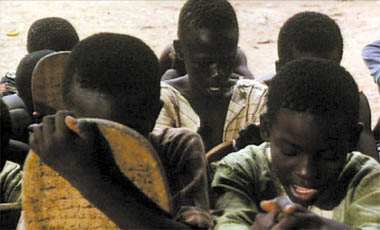
In a Senegalese village, a group of destitute children are gathered in the dirt around a seated priest, reading prayers from their tablets as the priest eats greedily from a bowl of food. One of the children, Madou, eyes the priest suspiciously, and turns his gaze to a bird’s nest perched in a tree above. The priest instructs the children, “Go and beg,” and they disperse. Madou wanders the village with a collection cup, asking for “Charity in the name of God.” One kind woman in the village offers him food. Madou next ventures to the marketplace, where a woman pays him to carry her groceries to her car. As Madou is looking in a storefront window, an apparently handicapped boy, who wears rags and pushes himself along while kneeling on a skateboard, rolls up to the curb and asks Madou for help crossing the street. After Madou has pushed him across, the boy stands up, exposing the artifice of his begging ploy (i.e., he’s not really crippled), and laughs at Madou. He introduces himself as Ablaye and the two boys make fast friends, wandering around together. As they pass a gated establishment – what looks to be a school – a boy in regal attire sits inside the gate, casually chewing food. Madou and Ablaye make eye contact with the boy, before continuing on their way. Next, they play a trick by filling a wallet with money and placing it in a suited man’s path. As the man reaches for the wallet, the boys cry out, “Thief! Thief!,” startling the man into leaving the wallet and moving on. In another scene, the boys watch from a distance as a birdseller sells a man one of his caged birds. Later, the boys exchange their respective stories: Ablaye’s father has lost his herd during a drought, while Madou’s mother has given him to a priest, for whom he must spend his days begging. Ablaye leads Madou to the garbage dump where he and his father live, and gives his father the money he has earned that day from begging. His father gives him permission to “go and play.” As the two boys walk off into the distance, Madou asks Ablaye if they will meet again tomorrow. “Maybe,” Ablaye replies. Madou walks home at night, in the rain. On his homecoming, he gives the priest the money he has earned. He lies down to sleep in the dirt beside the other destitute children. On closing his eyes, he has a dream that he is running freely along a beachfront. He stops at the edge of the shore, kneels, and holds out his arms to fly like a bird. He is replaced by the image of a bird flying upward toward the sky. End short.

While this is the “surface” narrative of the short, a second, metaphorical narrative is simultaneously told through the short’s innovative soundtrack. Madou’s sporadic voiceover narration is coupled with narrative lyrics sung by a child’s choir, to present the tale of a bird whose mother has left him alone in the nest, while a crocodile lies in wait down below. The crocodile lies to the bird and tells him that his mother will soon return, in an attempt to lure the bird down from the nest. The bird, however, knows the crocodile is a lying predator, and also knows his mother is not coming back.

Reading this analogy into the world of the film, the bird is representative of Madou, Ablaye, and the other fragile, motherless children who must make their own way in a world filled with predatory crocodiles – the adults (or, more specifically, adult males, since the females in the film are those who provide temporary, “surrogate mother” aid to the impoverished children), such as the priest, who, instead of offering protection, shelter, and sustenance, exploit the children for the sympathies of society, forcing them into a worldly wisdom beyond their years. The secondary narrative of the soundtrack intersects in moving ways with the primary narrative at opportune points. For instance, after Madou and Ablaye’s brief encounter with the boy they could have been – the well cared-for boy beyond the schoolyard gate – the child’s choir sings, “Mother help me! Oh! Mother. Help.” Similarly, as Madou lies down in the dirt at the end of the day, closing his eyes before his dream, the child’s choir sings, “Mother come and get me,” suggesting a desperate plea for escape, cried in vain. Later, there is direct dialoguic reference to the bird-crocodile symbology. After a stick-wielding street vendor chases Madou and Ablaye away from his premises simply because they are playing, Ablaye advises Madou: “The crocodiles are everywhere. Don’t let them eat you.”

To further the bird-crocodile symbology, there is bird imagery planted throughout the film. For instance, there is a beautiful composition as Madou first enters the marketplace, where we see him backgrounded against various cages of birds. The bird-seller scene is also quite striking. As the bird-seller reaches into his cage to pull out a bird for the customer, the first bird he pulls out is dead; he gives it no regard, throwing it onto the dirt, as we cut to Madou and Ablaye’s petrified reaction. (Another striking detail of this scene: Madou peers from behind a yellow sheet hanging on a line, while Ablaye, from a red sheet, to Madou’s right, thereby forming the rightmost two colors of the Senegalese flag.) There are also seemingly non-diagetic chirping bird sounds added to the soundtrack in various places, as when Ablaye and Madou exit the marketplace to venture into the desolate territory where Ablaye lives amidst disposable waste. The execution of this animal symbology is masterful throughout, culminating in the final, haunting image of Madou stretching his arms out like a bird by the shoreline.

What is distinctly non-American about this short are obviously the settings (a Senegalese village and marketplace), dress (robes, bare feet), and customs (eating without utensils, for instance) on display. On a more narrative level, the incorporation of the secondary, fable-like storyline, is distinct. The use of (especially animal-based) fable is an ancient African narrative tradition that is here synthesized and modernized, resulting in a hybrid narrative form where the secondary and primary storylines talk to one other and add to each other’s punch. The film has an agenda, advancing the cause of impoverished, exploited children in Senegal, but its reliance on metaphor allows it to avoid heavy-handedness, and instead present its subject matter in a subtle, affecting way. All in all, this will probably turn out to be one of my favorite shorts that I’ve seen. The kinship between the two boys is endearing, the film’s narrative structure is exquisite and complex, and its sequences are carefully composed and expertly shot. In sum, this is one of those short films that truly flies.

Sunday, June 18, 2006

A Alma do Negocio (The Soul of Business)


A ALMA DO NEGOCIO (THE SOUL OF BUSINESS)
Directed by Jose Roberto Torero, Brazil, 1996, 8 minutes
Source: hurluberu films (pause and skip the trailer)

A soothing musical score starts as a married couple are waking up and begin to advertise about everything they use to each other, the bed sheets, the shower, the towel, the coffee, the milk, etc. But when the wife cuts her husbands finger, she advertises about the knife. Then the husband advertises about the silverware and stabs the wife in the hand. The wife then advertises about the dishes and smashes it on the husband's head. Then the husband advertises about the meatmincer and.........yep, sticks the wife's fingers in them. Then the wife advertises about the skewer and stabs the husband in the chest. Then the husband advertises about the handheld blender and stabs it into the wife's chest. Then the wife advertises about the drill and drills the husband in the chest. Then the husband advertises about the new chainsaw and makes a huge cut on the wife's neck. Then the husband collapses on the chair as they are both dead, and then avoiceoverr advertises about band-aid.

This short film is supposed to be a graphic horror film but because the couple are speaking in the same uplifting commercial voice and trying to retain that fake smile while dying, it made me laugh when they were cutting each other up. I really enjoyed this film because with everything so perfect, so white, something this horrifying was bound to happen. This film was making a mock-up of the commercials with products that seem American, like the Michigan mix blender, the White&Becker drill, and Joe's Coffee. They don't actually look at the fourth wall to advertise but they do have an eyeline match to show that they are talking to each other. Quite a satire of American life with the couple being surrounded by name-brand products.

I chose this film because I thought it would be interesting to see what a horror film is like internationally. By watching this film I saw that graphic violence is more explicit. I saw long look at cut up fingers, at a wounded chest, and the full carnage of a chainsaw. Also I am intrigued by people like Jose Roberto Torero who not only directed this short but wrote it as well. JRT has directed and written many shorts but also made feature films like Pele Forever in 2004. Truly this film is very entertaining if not scary.

Tuesday, June 13, 2006

NEW YORK STORIES


NEW YORK STORIES
A) LIFE LESSONS, Directed By Michael Scorsese
B) LIFE WITHOUT ZOE, Directed by Francis Coppola
C) OEPIDUS WRECKS, Directed by Woody Allen
1983, 119 Minutes
Source: New York Stories ( DVD)

All of the aforementioned films are a part of omnibus entitled New York Stories. The theme is the life and times of very different people living in New York. We will explore the three characters and what makes them unique to New York.

In the first story of this triptych, Nick Nolte plays an establised artist, Lionel Dobie, working on a huge piece of canvas with a bare bones beginning of an idea. He is interrupted by his agent played by Patrick O’Neal, who is encouraging him complete the work. Dobie explains that it will have to wait until he retrieves his incompetent girlfriend from the airport. Now, we have a clue into his state of mind.

His girlfriend (Rosanna Arquette) is furious at him for showing up at the airport after she left a message on his answering machine that she wantd to leave him. By ignoring her request, Dobie is giving Paulette (Arquette's character) a backhanded clue as to his concern, or lack thereof, for her feelings. He continues with this mental abuse by alternately professing his love for her with bursts of insanity, characterizing himself as a lion among men.

His canvas is changing like Dorian Gray’ picture, reflecting his feelings towards Paulette. Unbeknownst to him, she watches him as he unabashedlyt splashies vibrant reds, smiling yellows and serene blues. The canvas is alive with passion, with good cheer and with serenity. It’s the changing faces of Lionel Dobie.

At Lionel’s next show,s we discover that Paulette has left him as though he is a failure. An ardent young woman enthusiastically introduces herself as new to the area, an aspiring artist barely making ends meet He tentatively suggests that could hire her as an assistant. The position doesn't pay much, he explains, just room and board.

I have never seen a short, romantic film directed by Martin Scorsese. I expected to see shooting, gangsters, people lying dead in the street. Figuratively speaking, that is what we saw in this scenario. Egos, dreams, and expectation are instead being shot down and left lying in the streets. Things that life lessens.

In Francis Coppola’s A Life with Zoe, we see another side of New York. When I think of New York I think of fantastically wealthy people inhabiting the city. What one doesn’t realize is that these “people” were actual children at one time, like Zoe. Her father, Carlos Montez, is a famous flautist who serenaded her in her crib. Her mother, Charlotte Montez (played by Talia Shire), is the most beautiful author who jet sets all over the world.

Her dream life has attending an exclusive school with equally wealthy children. One of whom is a rich, friendless boy that Zoe encourages to imagine a similar fantasy life, such as her own. Imagination is available to all, friend will find YOU.

Her father and mother reappear to tell Zoe that they are getting a divorce. In typical Coppoola fashion, however, namely a happy ending, the divorce doesn’t take.

New York Stories’ device is as a dream told to pyscharist by patient, Sheldon Mills shortened from Millsteins, (Woody Allen) after his mother is dead. He introduces Sadie, his mother, to Lisa, his fiance (Mia Farrow) at a magic show that that would be a family-friendly venue. The magician selects Woody’s mom out of the crowd to assist him in a classis box trick. The trick fails and hilarity ensues.

For the next three days, in a frantic effort of searching for his mother by using a private investigator, he is totally distraught. He even employs the services of a medium, Treva Marks (Julie Kravitz) though, unbeknownst to him, she is truly an amateur. However, for every step backwards there is a step forward. His lagging libido has been re-energized by the absence of his mother’s constant carping and criticism. His sex life is back on track.

Instead, she appears three days later as a humongeous cloud in the sky, from which she lectures him in front of traffic, causing a huge jam in the middle of New York City, as if that never happens in New York City. She also talks to people in the street as though she was right there, producing pictures on demand of Woody as a child, whereupon the other pedestrians produce pictures of their children and now the sidewalks are jammed.

When he tells his mother’s face that his girlfriend has left him because she cannot handle the duress of his mother’s absence, his mother miraculously reappears in his living room. Also there is the medium, Treva Marks( Julie Kravitz) who has admitted this she doesn’t know what she is doing as far as the occult is concerned, but she can cook. She’s even offered left-overs to Woody to take home, since she realizes that he cannot do for himself. (His life has been sheltered and provided for by his mother.)

This section movie is very typical of Woody Allen in the 1980s. He is very self-effacing and self absorbed but he finds the humor in situations, even though somehow I always got the feeling that these were situations he created in his own mind. There is a very dark side to his humor that I like. I hadn’t seen a Woody Allen film in awhile, so this was a refreshing retrospective.

submitted by Debbie Zukas
Monday, June 12, 2006

Twilight Zone: The Movie

SEGMENT 1 from TWILIGHT ZONE: THE MOVIE
Directed by John Landis, USA, 1983, 18 minutes (101 total)
(Other directors: Steven Spielberg- Segment 2, Joe Dante – Segment 3, George Miller – Segment 4)
Source: Twilight Zone: The Movie (VDD 263)

“You wanna see something really scary,” the character played by Dan Akroyd asks his friend.
“You bet . . . scare me!”
This interaction opens Twilight Zone: The Movie and foreshadows the campy, eerie, and psychologically intriguing shorts compiled on this film. This omnibus consists of four shorts (inspired by the television series) directed by four different directors. Segment 1 is the only short of the group that is not a remake, yet it fits into the omnibus perfectly and is the most interesting one because of its political implications.

In segment 1, a womanizing racist walks into a bar. Inside he meets his friends where he rants about how awful his day was since he lost a promotion to a Jewish man. During his diatribe he manages to not only make offensive comments about Jews, but about Asians and Blacks as well. However, the true story begins once the man exits the bar. He walks right out of the bar in 1983 (?) and into Nazi Germany where he is quickly stopped and questioned in German by the Gestapo. Before long he is being shot at and on the run. They believe he is Jewish. He is eventually cornered on a ledge where he is forced to jump right into the Deep South during a Klan meeting. This quick change of setting is flawlessly achieved and an interesting plot maneuver. On the ground before the Klan it becomes apparent that despite his white skin, the Klan members see him as Black. He is tied up and prepared to be hanged. Yet just as dexterously as before, he escapes his captures and dives into the river. There, he emerges in Vietnam where he is the suspected enemy being shot at by American troops. Finally, he is blasted back into Nazi Germany where he is detailed and placed on a rail cart certainly to be shipped to a prison camp. However, as he train pulls away, he sees his friends from the bar exiting that same bar in 1983. Though he yells and pleas, they cannot see or hear him.

Like every other short in this feature, this homage to the classic Twilight Zone television show is supposed to be scary, but ends up being predictable and a bit campy. However, what is interesting about this short is the filmmaker’s topic. This film is overwhelmingly didactic as it serves poetic justice to the racist. There is also a subtle comment here on war. The scenes here of the Vietnam war are grouped along with the Klan meeting and the Nazis. So is the viewer to equate American troops in Vietnam with Klan members and Nazis? Though this filming took place long after the Vietnam War, it is interesting to see this sort of blatant propaganda hidden in such a random place: a scary movie.

The other shorts included in this movie are less politically aware but all do end with a moral or comment on life. In Segment 2, directed by Spielberg, the character of Mr. Bloom brings levity to an otherwise drab retirement home and uses magic to physically transform the elder residents into youth through a game of kick the can. Near the end, however, the transformed individuals realize they want to be their old selves again, though they’ve now learned to remain mentally young. Segment 3 features a manipulative young boy who mentally and physically controls his “family” and an interloper who he lures to his house. The lured woman soon discovers that the people in the house are afraid of the young boy’s powers. Yet in a plot twist that is as irrational as predictable, she sees the boy as a charity case and decides to take him with her where she’ll teach him to be a more rational individual who controls his supernatural powers. The final short, one that has been parodied too often, a plane full of unaware passengers is tormented by a monster. One passenger sees the monster but cannot convince the others about the creatures presence. In the end, an engineer spots the damage caused by the monster and basically validates to the audience the man’s sanity. The lesson: perhaps the importance of trusting people?

As a whole, the most interesting aspect of this omnibus is seeing how each director updates the classic Twilight Zone style. Each teaches a lesson through gloom and/or fantasy and maintains a dark feel throughout by unnatural lighting. Yet the effects are still a bit amatuerish by today's standards and I found myself bored and/or laughing more than scared. However, the shorts did provide for some intellectual contemplation. I noticed that in some cases, these shorts are reminiscent of Greek or Shakespearean tragedies where bad things are happening, yet perhaps at the fault of one of the characters’ hubris. Perhaps this is what the Twilight Zone does for us, it provides a catharthic experience and life lesson similar to the tragedies of long ago.

Robert Altman's SHORT CUTS: "Neighbors"

Name of film: SHORT CUTS
Director/Writer: Robert Altman and Frank Barhydt, based on the short stories of Raymond Carver
Country: USA
Year of production: 1993
Length: 187 minutes
Source: DVD 1402


“I look at all of Carver’s work as just one story, for his stories are all occurrences, all about things that just happen to people and cause their lives to take a turn.”
--Robert Altman

The feature film Short Cuts is Robert Altman’s quilting of disparate short stories by Raymond Carver into one interweaving narrative. Joined by a series of incidental and coincidental ties among the various characters, and bridged by any number of visual, aural and thematic elements—including helicopter flying over LA in the opening sequence, the lounge singing of a mother and the cello music of her daughter—characters from nine of Carver’s short stories fill one world in suburban Los Angeles that shrinks via growing narrative crossover into the idiom, “it’s a small world.”

No one short story translates into one discrete unit on film, but rather each forms a narrative thread in a broader schema, each appearing and disappearing in sometimes cooperative, sometimes competitive interactions. Carver’s story “Neighbors,” in which one couple in an apartment complex agrees to housesit for another couple, translates into the heading for chapter five of the feature. Indeed the chapter features the two neighboring couples, but it doesn’t represent the beginning of that specific narrative thread nor does it represent only that set of neighbors.

The chapter actually begins with a shot of a pool and a pool man who turns to look for the source of cello music coming from, as he discovers, the second story window of a a neighboring house. It is then that the camera cuts to the story of the house sitters, who are in the process of receiving final instructions regarding plant care. The dolly shot that follows Bill Bush, the husband, from his bedroom to the window where he sees his wife at the neighbors’ receiving instructions shows a small, cramped apartment. It becomes more explicitly apparent, though it is already implied in a previous strand of the narrative, that the Bushes do not enjoy the same lifestyle as their neighbors. In later strands the viewer understands how disparate these lifestyles are, despite proximity.

Carver’s story rests not only on the theme of economic inequality and attendant jealousy, but also on the intrigue of seeing from an intimate viewpoint another’s life and the disappointment in one’s own life that a comparison might yield. The chapter cuts back to the pool and the pool man who, though not a literal neighbor of his clients, will come to sense a similar envy or disappointment as he spies in a subsequent narrative strand, undiscovered, the cellist strip off her clothes in perceived solitude and jump into the pool. The owners of the two neighboring pools seem to know so little of each other and seem to care so little for each other’s lives, so wrapped up they are in their own, that the term “neighbor” takes on little more meaning than proximal domiciliary.

In this narrative thread, then, these neighbors can hardly comment on their neighbors’s lives, while in the thread related to the Carver story proper, the house-sitting couple can’t help but imagine the life they might lead if their lot and their neighbor’s were swapped. In both cases, “neighbors” takes on an antithetical meaning to the positive communal connotation it usually carries.

Altman writes that Carver’s stories are “more about what you don’t know rather than what you do know, and the reader fills in the gaps, while recognizing the undercurrents,” suggesting a format commensurate with that of the short film, which in limiting the time frame for the development of a narrative demands economy in the telling of the story. The title “short cuts” embodies this economy (and defines both the narrative structure, which most often cross-cuts among story lines, and the filming technique), but its usage here is nothing if not ironic, because no one chapter comprises any discrete narrative arc, and no one narrative strand can stand alone.

In this sense, too, the film is neither a “compilation” of short films nor a “collection,” and so the definitions we batted about in class fail, in my opinion, to define this feature film, which fits better under the rubric of adaptation of an omnibus of Carver’s short stories. From a Saussurian point of view, however, this failure of Short Cuts to fit the definition of the omnibus short film may do more to help define the term than anything else. It suggests that the capacity to stand alone may be the single defining characteristic of a short film omnibus. Whatever seems to qualify the shorts for compilation in one discrete unit can then be incidental or coincidental or thematic, not unlike that which ties the lives of the characters in Short Cuts together. For Altman there is more than authorship in the relationship among these narratives. “In formulating the mosaic of the film Short Cuts, which is based on these nine stories and the poem “Lemonade,” I’ve tried to do the same thing—to give the audience one look. But the film could go on for ever, because it’s like life.” If we are to call Short Cuts an omnibus anything, it is based on the concept that human experience is, though multiple and varied, so very similar.

Go

SIMON
From GO
Doug Liman, US, 1999, 103 minutes (SIMON is approximately 30 minutes)
DVD


GO is a film made up of three shorts--each revolving around a central character, though there are several main characters that make appearances in every short. The movie is set up with Claire (Katie Holmes) at a diner talking to a mystery man--all we see is the back of his head. Claire mentions how yesterday she never would have thought she'd be there with him--and thus we are sent back to yesterday to find out through a convoluted mess of circumstances how Claire ended up at the diner.

The first short is entitled "Ronna." Ronna is a supermarket Clerk who is going to be evicted if she doesn't come up with some fast cash. She volunteers to take over a shift for Simon, who says he is off to Vegas with some friends. Ronna not only takes his shift at the supermarket, she also ends up taking on a pair of his drug clients. (Scott Wolfe and Jay Mohr). Ronna goes to Simon's dealer for her first big deal and after leaving Claire with Todd (Timothy Olyphant) as collateral, she goes to make the deal with Adam and Zack. The deal goes bad when Ronna figures out she's being set up and she ends up flushing the pills. She tricks Todd into thinking a bottle of aspirin are the ecstasy tablets she's returning, and then she, Claire, and another friend Manny (who has no real part except comic relief) go off to a rave to make some money on stupid kids who can't tell mind-altering drugs from allergy medicine. All is well! Yes? No! Todd finds Ronna and is about to shoot her in the parking lot when... She gets hit by a yellow sports car! I guess that solves that....

The second section, and the section I will later focus on, is SIMON. Once Simon leaves for Vegas, we find that he is stuffed into a trunk. Oh my gosh, why is Simon in a trunk?? Oh, I get it, it's just a prank. His friends are so funny. The four guys get to Vegas and Simon loses his money gambling. Then he meets two girls and has sex with both of them. Then they set the hotel room on fire. Then he goes to a strip club, gets in trouble with a stripper, and shoots a bouncer. The rest of the short is Simon and his friends trying to get away from said bouncer and said bouncers father. The short ends when the bouncer's car crashes and overturns and the four friends get away.....

The final short is entitled ADAM AND ZACK. Adam and Zack are actors who got busted doing drugs. (Entertainers do drugs??? WHAT???) They're also closet homosexuals who are cheating on each other with the same guy. Oops. Adam and Zack make a deal to set up Simon, who always provided their drugs, but when Simon's out of town, the cops settled for Ronna. We get the same scene at Adam and Zack's house with Ronna and the drug deal, except this time we see that Zack mouths the word "Go" to Ronna just as she's beginning to get suspicious. The boys still make their deal, but the cop in charge of the bust asks them to come over for dinner. Strange events ensue, nothing pivotal to any plot, anywhere, ever. Adam and Zack end up taking their yellow sports car after the guy they had both been sleeping with who is at the same Rave where Ronna and her crew is. And yes, if you haven't guessed it, it is Adam and Zack that send Ronna flying into a ditch. They decide to save her--no, run away--no, they have to go back and get the body! They do go back, but she's alive! Hooray! They leave her on the hood of a car where teenage kids call 911. At least someone has some good sense in this movie.

After Adam and Zack's story is finished, we get an ending to the entire film in which Claire ends up in the diner with... Todd! The drug dealer that just a few hours ago she was terrified of! Well, now with the help of some ginseng and afore mentioned mind-altering drugs, she is Chatty Kathy and happy to have company. They end up at Todd's apartment where the Vegas bouncer and his father are waiting for Todd! (Did I forget to mention that Simon had Todd's credit card? My bad.) Todd explains the situation just as Simon bursts through the door asking to hide out with Todd for a while because--- oh my god! The crazy bouncer! In the end they decide that the bouncer can shoot Simon's arm for retribution and everyone lives happily ever after.

Just kidding, there's actually ANOTHER ending after that in which Ronna limps back to work, she and Claire realize that they left drugged-out Manny at the rave and they go rescue him.

The End.

So, I'm not completely convince that GO can really be considered an omnibus since there are several threads that aren't explained within the confines of each short. It would in no way be satisfying to see Ronna get hit by the car is you don't later see who was driving the car. Or, if we got Adam and Zack's version of the accident, we would left wondering who the man with the gun is and why was he going to shoot Ronna. But I guess if you don't ask questions they are three distinct and interesting shorts, if not convoluted and contrived, but I think most of the humor lies in the outlandish situations.

I did think that SIMON was the most complete of all three shorts in that it's characters were somewhat contained within the boundaries of the short. The music struck me throughout the film, but definitely within this story. There is a lot of techno crap (oh lord, I just felt my grade in the course drop a letter) but every once in a while the scene will shift, the guys wil jump in the car and we're listening to Magic Carpet Ride. The music was pretty surprising like that. Most of the entertainment in this section was from the humor that is stuffed in like a TV sitcom. Simon's has a magnetic pull to trouble and every step is bigger than the last. (There's a very self-reflexive moment--after he tells the girls that he learned to drive by watching American TV, we get the car chase full of screeching wheels and alley way detours.)

What impressed me as a whole about the movie was how the filming fit the story and the characters so well. There are a lot of fast cuts, and scene shifts, all of the rave scenes are filled with flashing lights and hazy views. Form and content meshed extremely well.

The threads that are laced through the different sections, though disruptive of the omnibus, offer many "aha!" moments and not in a tricky way, but a revealing and interesting way. Even though I'm skeptical of the omnibus-ness, I like how really the three sections can be held separate. I wonder if "RONNA" would make a good short with the ending as-is-- Ronna getting hit by the car, lights out, the end. i think it would be unexpected by welcomed.

Again, a lot of this movie is filled with unlikely circumstance, but once you suspend your disbelief and go with all the crazy unfortunate events, it's actually both funny and clever.

Sunday, June 11, 2006

Things You Can Tell Just by Looking at Her


“Fantasies about Rebecca” (~30 minutes)
Written and Directed by Rodrigo García , USA, 2000
Source: Things You Can Tell Just by Looking at Her, 109 minutes

Things You Can Tell Just by Looking at Her is four “slice-of-life” shorts about a variety of loosely connected women living in Los Angeles, threaded together by recurring images of birth, death, and the loneliness in between. The film opens with a quick glimpse of a detective (Kathy) at a crime scene, while a dead woman in a red dress lays on her bed. The first short, “This is Dr. Keener,” focuses on Dr. Keener (Glen Close) caring for her mom and trying to overcome loneliness. The next short, “Fantasies about Rebecca,” follows Rebecca (Holly Hunter, who was nominated for a 2001 Emmy for this role), a bank manager who discovers she is pregnant with her married lover’s child. “Someone for Rose,” introduces Rose (Kathy Baker), a children’s writer and single mother struggling with social/sexual awkwardness with a new neighbor. In “Goodnight Lilly, Goodnight Christine” Christine (Calista Flockhart) cares for her dying lover, Lilly (Valeria Gollino) in a very moving short. In “Love Waits for Kathy,” we return to detective Kathy (Amy Brenneman), who lives with her beautiful blind sister, Carol (Cameron Diaz). Kathy and a pathologist try to piece together the death of the woman in the opening scene, a high school classmate, while Walter, Rebecca’s coworker, takes advantage of Carol, who happens to be his blind daughter’s new tutor. (According to imdb.com trivia, the braille book Carol and Walter's daughter are reading from is One Hundred Years of Solitude, a nod to the director's father, author Gabriel Garcia Marquez.)

“Fantasies about Rebecca” opens with a shot soft lighting and sultry music playing while Robert (Gregory Hines) kisses Rebecca’s back before leaving. We next cut to Rebecca taking a pregnancy test at work. Later, Rebecca is approached by Nancy, a bag lady who bums a cigarette and starts an interrogation in the bank parking lot. Nancy first asks if Rebecca’s a whore and then later accuses her of sleeping her way to the top at work. Rebecca is insulted, but let’s it slide. Nancy asks for the rest of the cigarettes and suggests Rebecca make one of the men buy new ones; they’ll be happy to because they surely fantasize about her anyway. Later, Rebecca asks her coworker Walter if the men fantasize about her and he replies, “I’m sure they do.”

At the doctor’s, while Rebecca learns she is six weeks pregnant, we learn that Robert is married and that their affair has stretched over the past three years. Rebecca seems calm about the pregnancy and requests an abortion. When Debbie, the doctor-friend, prods and tries to convince Rebecca to think it over, Rebecca resists and schedules the abortion for the earliest time the next afternoon. That night Robert stops by for a glass of wine; he doesn’t object to the abortion, only states he won’t be back in time to pick her up (that’s OK she says) before quickly changing the subject to draperies. There is a shot of their wine glasses together on the table and after Robert leaves, Rebecca is left eating by herself in the dark room. Her loneliness is palpable. Later that night, she spots Walter walking into a bar. She follows him, joins him for a drink and then sleeps with him. She leaves while he is sleeping.

The next morning they arrive at the bank at the same time. Walter hops into her car just as Nancy approaches. Among other things, Nancy accuses Rebecca of adultery and calls her “a sad bitch, a loooonely bitch” and then assures her, “It’s not that I don’t like you princess. I feel sorry for you.” Nancy tries to barge into the bank that afternoon, but a security guard pushes her out. When Rebecca leaves to get the abortion, she finds Nancy has left a cigarette carton with her own alleged wedding ring inside under the windshield wiper. After Rebecca’s abortion, performed by Dr. Keener in a quick scene punctuated with the mechanical clicking of metal surgical tools and Rebecca’s calming breaths and winces, Rebecca she leaves alone. In a long, heartbreaking shot, Rebecca starts walking away with a confident gait, but becomes weaker and stumbles into a bush where she finally allows herself to cry. This emotional breakdown is the most moving part of this vignette. For the first time we sense she may regret her decision or is at least overwhelmed by the situation. Once she composes herself, Rebecca continues walking and stops to cross the street. After watching the movie a second time, I got the chills when I realized a woman who stops behind Rebecca at the corner, for literally a second, is the woman walking in front of Dr. Keener’s house (in a blink at the very beginning of the film). She also happens to be carrying a red dress in a dry cleaner’s bag….soo I’m guessing she is the dead woman Carmen while she is still alive…or in ghost form. “Rebecca’s Fantasies” ends with Rebecca watching Nancy push her shopping cart across the street.

“Rebecca’s Fantasies” is an interesting short on its own because it explores the complexity of a seemingly cool, collected bank manager, who may be her coworker's fantasy, but in reality is lonely and and fragile. Though viewers and Rebecca want to dismiss Nancy as a lunatic, it becomes clear that she has some thought-provoking insights that hit a little too close to home. This segment fits in well with the other stories because there is the obvious recurring theme of loneliness (which isn’t limited to the women in this movie, the men are also lonely), as well as the notion that the lives of all of these women are much more complex, and sometime totally different, from what they may appear to be. These shorts are sometimes slow, and the story lines deceivingly simple, but like the women themselves, are actually quite complex and human. After watching them all a few times, I am convinced that every minute detail is calculated by Garcia as these subtle references, from the repetition of images, such as canaries or professions, such as writing, and casual references to common friends, these pieces are all pulled together at the end when their final scenes are interwoven with those of Kathy and Carol’s. These relationships with each other never seemed forced and each short was compelling on its own, with beautiful, if not sometimes haunting music and camera work. There was an alternately straight-forward and dream-like feel to the whole film.

I found it really interesting that we begin with the mystery of the dead woman, Carmen, and though the pathologist warns, “she’s not going to tell us all of her secrets,” during his initial evaluation and though Carol echoes these words “only a fool would speculate about the life of a woman, ” at the end, through the glimpses into the life of these other women, and the clues we have about Carmen, we can conclude that yes, we will never fully understand her story, her apparent suicide motives, but perhaps we have an idea of the roles she may have assumed before her own death: caretaker, mother, daughter, lover and the bittersweet aspects of each. So, yes, there are some things you can tell by just looking at "her," but a second or third glance may be just the beginning.

New words for Omnibus films

Earlier this week, we discussed how there isn't a formal word for short films that share a similar theme, lots of websites say omnibus films, anthology films, or compilation films. Since we are a new class subject, it would be nice to create a new word for this idea.

Now the way I see it, 4 short films and all have one theme, is the same way as saying, four brothers and all have one DNA trait from their father (the theme). So it would be great if we use wording from that biology technique to use it from this idea. I think of words like genome, chromosome, gene, trait, and DNA. But I think that the word should sound French to make it sound original (also we would give the French credit that they won't thank us for....again). Unfortunately all of these words sound or look the same French, except heredity. So I would like to nominate this word for this idea: hérédité films.

Your thoughts?

Frank Miller's THE BIG FAT KILL


THE BIG FAT KILL
Directed by Alex Rodriguez and Frank Miller with special guest director Quentin Tarantino, USA, 2005, 44 minutes.
Source: SIN CITY:recut-extended-unrated (DVD, disc 2)

One of my favorite short films once I found out in this class that this is actually a short film, is either story from the triptych of the Recut-Extended-Unrated edition of SIN CITY, an over-the-top adaptation of the B/W graphic comic novels from creator Frank Miller who also co-directed this movie (which is why he is given credit in the title). For this blog I choose THE BIG FAT KILL. Why this one over the others is later. This is what this film is about.

Dwight is a man with murder in his past and a new face. He is in his girl, Shellie's apartment in Basin City when the girl's nasty ex-boyfriend barges in with his friends drunk and looking for a good time wanting Shellie to make some whore calls. Dwight confronts Jack in the bathroom telling him to stay away from Shellie, so Jack and his friends leave. Dwight knows that the next girl Jack and his gangs meet might get hurt...or worse, so Dwight follows them into Old Town where the prostitutes are in control of the area. Dwight is met up by his old flame, Gail, and they both see Jack's car trying to follow a young hooker, Becky, into a dead end alley. There they trap him and with the help of their samurai style mercenary gal, Miho, Jack and his boys get killed. Jack gets the worse by getting his hand cut off, his gun barrel backfiring into his skull, and being made a Pez dispenser out of his neck. During the collection of possessions from the dead bodies, Dwight found out that Jack was a cop, and Gail knows that for letting the hookers control Old Town, any cop who is not there for fun, is sent back alive, the Truce of Old Town. If this gets out, the truce would be broken and the pimps and the mob would take control of the town and the hookers again. Dwight agrees to hide the bodies in the tar pits, but even cut up not all 5 bodies can fit in the trunk of a car, so Jack was put in the passenger seat. While Dwight is driving, Jack appears to be alive talking in his deceased state, apparently being a negative enforcement on Dwight, when a cop pulls him over fortunately for a broken taillight, unbeknownst about Jack. When Dwight tries to push the car into the tar pits, Irish mercenaries knock him out and take the head of Jack. They tossed Dwight into the tar pits. But then Miho comes to kill a few guarding the pits and rescued Dwight. They come to find out that Gail is kidnapped by the mob because of Becky, the informat. The mob sent the mercenaries to give them Jack's head so they can hand it to the cops. By leaving one alive to talk and be tortured, Miho helped Dwight find out which way the mercenaries were heading. Dwight and Miho were able to find them, kill them, and get Jack's head. Miho sends a message to the mob that they have the head and if the mob wants it, the large mob group is to come to the crooked narrow back alley with Gail. There they give Gail to Dwight then Dwight gives the mob the head, which he detonates the grenade in Jack's mouth and all the hookers on the top buildings surrounding the back alley kill every last man in the mob. The big fat kill.

That was certainly the most I have ever written about a short film, but I love this so much every thing needed to be told, that way people will see that the story is just the half of what makes this short great. When I took this short films class and the word omnibus came into play, I automatically thought of the recut edition of SIN CITY. At first I was told that it wasn't an omnibus short film, but through more research it was discovered that a movie that has stories with no interwinding characters or scenes are considered omnibus shorts. I rejoiced. Just like the director Alex Rodriguez did when he was making this movie. Alex knew that he could not do this adaptation without authenticity so he brought in Frank Miller to co-direct the movie, making sure that everything was as precise as his comics, every action, every angle, even lighting. There is a scene where Dwight is drowning Jack and the scene is bleached to make it look the closest to the comic panel in the novel. A sign of the Alex's faithfulness to the adaptation.

Though some people believe that this was "Film-Noir on steroids." because of the over-the-top acting, the acting is supposed to be faithful to the comic characters where everything is over-the-top for visual reasons. Speaking of visual, the one thing that was really amazing was the specific objects that were given color in this B/W short, Like Dwight red shoes and car, Jack's blue car, Becky's blue eyes, and certain moments of blood. I do believe only the primary colors were used but mostly red and blue. These specific objects were not colored just for show, and it only made the short even better.

Why I picked this short over the other two are the slight differences. For example, in both THE HARD GOODBYE and THAT YELLOW BASTARD, you hear the central character's asynchronous narration immediately. In the BIG FAT KILL, the narration is not heard in the beginning and we get to see the interaction between Shellie and Jack first. Even when Dwight first speak we don't hear it yet because we need to see his emotion when he drowns Jack seeing how feels when he assaults someone. Only after he heads for his car does the narration begin.

Another reason why I picked this short over the others is that this contains a sequence that Quentin Tarantino was a special guest director for, where Dwight is driving with Jack in the passenger seat. Using from what he saw in an Italian movie, he used a variety of colors flashing by in the car (using a cool light and a warm light for special effects), and a scene where Dwight is actually speaking his asynchronous narration while Jack is supposedly undead. That part was not in the novel but it worked so well that Frank Miller allowed in the short. The specialty just adds more excitement to the short.

What makes the three shorts in SIN CITY connect, other than the same visual adaptation of the comic novel, is the atmosphere of Basin City where all the shorts takes place. Everything just seems like the people are living in Hell. You don't actually see an entirely good person in this triptych, everyone has a form of darkness inside of them. Every central character seems to be forced to kill, whether it is killing for revenge (THE HARD GOODBYE), killing for protection (THE BIG FAT KILL) or even killing for justice (THAT YELLOW BASTARD), it just seems like the right thing to do in all three shorts. Even the killing was done over the top in all three shorts which really intrigues me because no other film that I know of has killed or tortured as graphic as these shorts. Also in THE HARD GOODBYE and THAT YELLOW BASTARD there is a highway sign indicating Basin City is close by. Though THAT YELLOW BASTARD was shown last in the movie, only in THE HARD GOODBYE did the sign had the B and A in Basin City scraped out making it look like the word SIN CITY. Showing that this city has been Hell for a long time. And what a hell of a city to be Hell itself.