Showing posts with label experimental. Show all posts

Sunday, December 04, 2011

Quintessentials- Drinking Out of Cups

Original Post -> http://shortfilmsblog.blogspot.com/2011/10/drinking-out-of-cups.html


The original post argued that Drinking Out of Cups is an experimental film. I disagree with this categorization. The original argument is that because Drinking Out of Cups has no narrative than it is experimental. I think that this is simplification of what an experimental film is.

If Drinking Out of Cups is experimental, than what is the experiment? An experimental film is trying to do something different with structure, technique or writing. Drinking Out of Cups is certainly not something that we would normally watch in a movie theater, but it is completely within the normal elements of its context.

Drinking Out of Cups is not an experimental film, it is just a meme film. For a youtube video that is intended to be funny, plotlessness is not only not experimental, it is par for the course. I do not find Drinking Out of Cups to be particularly odd for a youtube video. This makes it unexperimental.

Wednesday, October 26, 2011

Fireworks (1947)

Part 1
Part 2

Fireworks
Kenneth Anger
1947, USA
14 Min

Kenneth Anger's "Fireworks" is a statement about the difficulty of being a homosexual in 1940's America as well as an exploration of the thoughts and feelings of a gay teenage boy trapped in such a culture. Anger's own synopsis of the film states: "A dissatisfied dreamer awakes, goes out in the night seeking a `light' and is drawn through the needle's eye. A dream of a dream, he returns to bed less empty than before." I believe the identity of this "light" is first revealed when the "dreamer" exits the place he had been sleeping through a door marked "Gents." "Light" symbolizes, in my opinion, the fulfillment of the boy's sexual needs. Thus, he goes out into the night looking for "light" and finds it in the form of a muscular sailor.

In the next scene, the "dreamer" is attacked by a group of sailors and beaten badly, cut with broken class and would have had his heart cut out if his heart had not been a gas gauge. Milk is then poured over the "dreamer", a sailor that is meant to seem larger than life then appears with a firework protruding from his pants. He lights said firework and a stream of sparks fly from its tip. The next scene is of a burning Christmas tree and the final scene is of the view of the "dreamer" in bed with a sailor with his face disillusioned by light.

In my opinion, the film is filled with a great amount of symbolism starting with the muscular sailor who I believe is the "dreamers" ideal man, the kind of man he wishes to pursue. The scene in which the "dreamer" is beaten and cut with glass could in fact be a scene in which the character is being raped by a group sailors, brutalized by them, and finally covered in semen (milk). This part of the film confused me and if I followed the train of thought that this scene was a rape scene then it might be an expression of Anger's own homoerotic sadomasochism. The image of the sailor with the phallic firework also led me to this notion as he appears to be "larger than life" and has "light" protruding from his metaphorical phallus. The final scene of the "dreamer" in bed with the sailor whose face is obscured by light leads one to believe that the dreamer found his "light" and that is the reason he returns to bed "less empty than before."

Overall, I believe this film is an exploration of being a homosexual in 1940's American and what it meant to attempt to fulfill the urges that one finds running through their mind at night.

Tuesday, October 25, 2011

Mongoloid - Devo music video by Bruce Connor


Bruce Connor
1977, USA
3:37


This music video follows much of the same pattern as Bruce Connor's "Movie," the short film we watched in class: bizarre images from spectacles and popular culture smashed together into a whimsical weird montage. In that film, music often contrasted starkly with image to create a witty feel of ironic tension. (Witness men falling off jetskis while somber high-drama music blares on in the background). Much of the same technique is employed by Connor here. This time Devo's "Monogloid" makes up the entire soundtrack though. The song, with it's ironically simplistic chord progression and bleating vocals, makes the perfect contrast to 50's images of smiling men in lounge chairs, a man pulling a bus with his teeth.

Much of the video is filled with old imagery that looks like it could have come from a television special about how the brain works. We see people's heads attached to wired caps, animations of crossing lines perhaps meant to look like neurons, and a sketched cross section of the human brain's reaction to a plate of food. There are also recurring images of bucolic suburban life: waving to the post man, people wearing cardigans, reading papers happily behind desks, clips from cereal commercials, etc. While these images on their own might be difficult to assign meaning to, with the aid of Devo's self-conscious irony, they become instead witty commentaries on what it means to be really brain dead.


View the video here

Wednesday, October 29, 2008

COPYSHOP

Virgil Widrich, 2001
Experimental


(Clip on Cinema 16's Youtube Channel)

Sources:
Cinema 16 : European Short Films
and
The Best of Resfest: Vol 2

This is by far my favorite short film. The story: man accidentally photocopies his hand and consequently himself. The copy of himself copies itself. Soon there is nothing but copies of himself everywhere and he must put to a stop to the machine that created the copies that are filling up the world around him.

Seems pretty straightforward. Well, gosh, Kylos that's not that experimental. In fact, it sounds just barely engaging at all.

Putting aside the Dr Seussian metaphors we can draw from the photocopies filling up the world (need anything from walmart?... starbucks can you answer the door?... what' the latest on cloning technology?..... i'm going to name my kid "internet meme") and the lessons to learn... let's examine a particular production path taken by the director that is decidedly experimental and just a tad bit evil genius.

First... they shot the film, way back on antique state of the art dv equipment in 2000. They used partial sets and one main actor. Then they used green screen technology and compositing software to flesh out the environment and add more and more versions of the character.
Pretty straightforward approach for copying a dude a ton of times. Hell, I can do that right now with the software i use everyday. I composited six of myself while typing this.
But wait... there's more!

Then they printed out EVERY FREAKIN FRAME of the film (it amounted to about 18,000 print outs) and then PHOTOCOPIED them all. Are you with me? Then they photographed each copy of the film with a 35mm film camera so that what you're watching is a copy art approach to telling the story. In a sense, they've inherited Stan Brackage's Mothlight technique and adapted it to Copy Art. See what I mean.... evil genius.

For more info, including a short documentary on the making of the film - here's the website.
I couldn't find a full clip online, so if you want to watch the whole thing... I've got two copies you can borrow.

Wednesday, October 22, 2008

I am (not) seen

Director: Takahiko iimura
Duration: 5 minutes
2003

I, like many others in my class, am very unfamiliar with experimental film. I didn't have any in mind so I turned to Netflix to help me in my quest to find an experimental short that I a) somewhat comprehend b) am able to write more than a few sentences about. Fortunately, Netflix saved the day! I stumbled upon a series of DVDs called "Different Cinema" which features 10 short films from all around the world that, at one time or another, have hit the industry. I went through about 2 of them before I came across this one.

I am (not) seen is a short with absolutely no dialogue or story. The short deals primarily with the one's sense of sight and features such sentences as :I am seen, I see you and I am not seen superimposed over pictures of a face, eyes , ears and forehead of a person. The video is constantly moving in a rapid motion with stills of the person's face or close up of his eyes occasionally popping up. Towards the end of the film, the video moves even faster and the still shots are zoomed in on the person's eyes more so than before. The music through out the short goes hand in hand with the rapid motion of the film. It's loud, scratchy and repeats over and over. The way the film ends leaves you almost in a trance because it ends so suddenly and goes straight from complete mayhem to a black screen with no sound.

The director/man featured in the film, Takahiko Iimura, was a pioneer of experimental film in Japan and once he moved to New York City in the early 60's he became very well-known internationally for his numerous shorts and video arts, as he called them. One short, called LOVE (1962) featured music by Yoko Ono. Her participation in that film definitely boosted his career in the United States. He is also well known for other various artistic works including performances and installations.

I enjoyed this film immensely. Although it appears very simple and perhaps boring, I find it extremely artistic and interesting because of its use of still photographs and simple phrases to represent the sense of seeing and how deceiving our perceptions can be. (that's a mouth full.)

** There was no video found of this short. If you like the concept though, I highly suggest renting Different Cinema Vol. 1 & 2

Rejected


REJECTED
Directed by Don Hertzfeldt, United States, 2000, 9:21
Source: Bitter Films

I must say that experimental films are not my area of expertise, so when I saw that I was blogging about one, I was totally unsure of what to write about. The genre classification of "experimental" is so vast and all inclusive that there could be upwards of 30 different classifications under that wide umbrella. Overwhelmed and relentlessly searching for an experimental short that I felt strong enough to write about, then I remembered a video that had my friends and I laughing in high school.

Don Hertzfeldt's "Rejected" is a humorous-animated-experimental short film (sort of a mouthful)that was nominated for an Academy Award in 2001 for best animated short, and won 27 awards from various festivals . The basic premise of the film is an animator who was asked to animated commercials for various companies, but the animations were so bad that they were immediately rejected. This rejection causes the cartoons to become destabilized and run into each other as the creator presumably loses his mind and potentially life.

The overall nature of the piece itself is very experimental, the idea of bad cartoons getting rejected, causing pain to the creator, but we only see the animations. In class we talked about the Non-sequitur, which translates to "does not follow," and these little surreal vignettes have no connection to each other and lack connection within themselves individually. We first see a man with a giant spoon that is clearly too large for his tiny bowl, in walks a banana that exclaims, "I am a BANANA!" This advertisement was for the family learning channel. It is this awkward unconnected humor that drives each little section. Some of the other shorts within the short include blood fighting, a bleeding anus, a man being beat to death for not wearing a silly hat, angry ticks shooting out of nipples, a baby falling down the steps, dancing in blood, and a few more.

These unconnected and sometimes disturbing visions remind me of the Dali piece "Un chien andalou." However the experimenting doesn't stop there, the animation techniques at the end of the film, when the creator begins to go crazy, are very edgy and incredibly well executed. The drawing begin interacting with the paper in many ways: the paper crumbles and closes in on them, two figures knock on the paper's surface pushing it out, and finally the black hole the sucks in all of the animations before closing in on itself. These unorthodox techniques break what I would call the "fourth wall" of animation by openly showcasing that they are merely drawings, but the individual characterizations are in a dire situation (end of their world) just as their creator is (possibly the end of his world).

Overall I'd say this film is pretty amazing. Some of the awkward connections and random bits of dialogue are very very funny and creative. The animation techniques are almost jaw dropping. It is easy to see why this short did so well in critics' eyes as well as ordinary viewers. This short has developed a cult following (similiar to that of Rocky Horror Picture Show). This film is a success, and in my mind one of the more enjoyable (still absurd) experimental shorts I have ever seen

All is Full of Love


Directed by Chris Cunningham, USA, 1999, 4 minutes
Source: http://www.youtube.com/

To be honest, I am not that familiar with experimental films, so I went through really a hard time deciding what films to write about. At first, I was thinking about writing my entry on Mongoloid by Bruce Conner, but it was really complicated, and had trouble understanding the film. I looked up some of Björk’s music videos, and chose the one that I like the most. That is All is Full of Love. Two robots are shown in the film, and the music video reminded me of a movie, I, Robot, which I enjoyed very much. The color of the film also attracted me. The contrast of the robot’s white color and the background’s black color appears beautifully in the music video.

Björk’s music videos are famous for being both experimental and surreal. Not one of her music videos is “normal” at all. I do not really understand what relationship her music videos have with her song lyrics. In this music video, All is Full of Love, Björk’s voice is mystic and dreamy, but it sometimes gives me creepy feeling when I listen to the music at night alone. The lyrics express that everything is full of love, and the two robots in the music video are matched well. The robots take place of Björk and sing as she sings, and their love reaches climax as the song reaches its climax.

One day Björk woke up in the morning and made the song all of a sudden as if she was possessed by something. Although it is made in such a short time, it certainly is a great song. The lyrics are really heart-warming, and the music video of the song is even more charming than the song itself. I like the delicacy of the robots that are used in the music video. They are really similar to humans. In fact, the robots in the film are hand-made out of clay. To show Björk’s figure better, Björk actually posed for the robot, and technicians added computer graphics on Björk’s body. The movement of the robots is not only computer-generated, but also the hand work of the staffs. The staffs had to move every single part of the robot in order to make the movement look real, just like the process to make a stop motion animation. In the end, I had trouble distinguishing what is computer graphic and what is the hand work. Thanks to the effort of the staffs, the music video won MTV 2000 Breakthrough Video and Best Special Effects. In addition, it won the best music video in 42nd Grammy in 2000 and many other awards.

When the director Chris Cunningham was offered to make the music video, the only thing Björk wanted to show in the film was the feeling of ‘the most pure whiteness.’ It is amazing that Cunningham came up with the idea of robots that look and act like humans. Their eyes add the liveliness of human in the cold body of a robot. Just like the lyrics of the music, the music video is symbolic, too. I believe the robot, which appears in the first place, is born at the beginning of the film, since it poses like an unborn child on the conveyor belt. Throughout the film, the robot goes through various processes and at the end the robot is completed. By showing the procedure of a new robot being born and making love, the music video gives a hint that there will be another new life born.

Tuesday, October 21, 2008

Rose Hobart


Rose Hobart
Directed by Joseph Cornell, 1936, 19 minutes

Part 1

Part 2

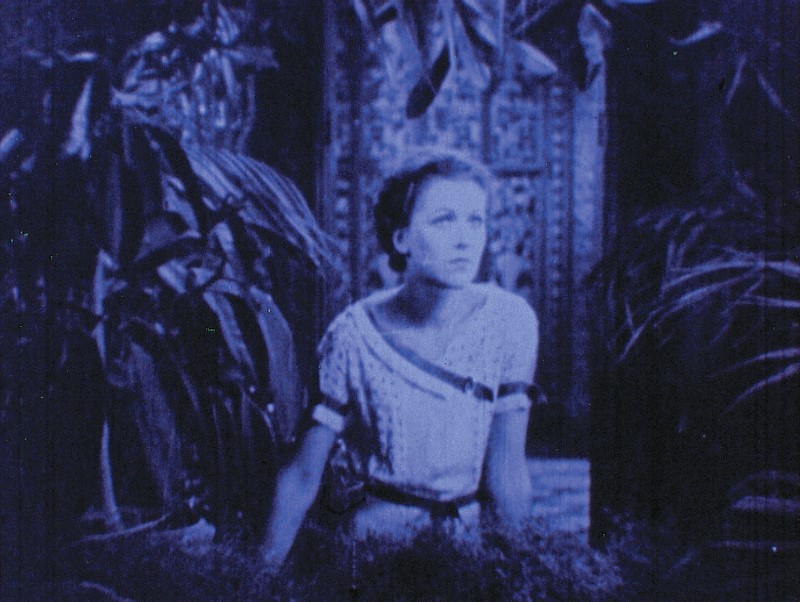
Not matter how snobby of a film enthusiast/elitist one becomes, there’s always a desire, even if miniscule, to indulge in bad cinema, every once and awhile. Often it’s a B-movie, one that never escapes its genre and fails to live up to one’s low expectations. Yet some great moments pop up, infesting your subconscious for weeks until one drunken late night, when you and your buddies are on the verge of slumber, somehow you decide to watch the B-movie again, this time fast-forwarding through all the crap to the moments you remember and love. You might even be too lazy to turn off the 4 Non-Blondes mix you’ve got pumpin’ from the Bose, but it doesn’t matter, because "What's Up?" makes the said B-movie even better.

Now at no point in this situation would one think that they were an artist, but stoned enough, one might believe that they were the first to do something like this. Paging Joseph Cornell. The famous surrealist mixed media artist of the 20th century, known more so for his hand-made boxes, Cornell created one of the first examples of found footage cinema with 1936’s Rose Hobart. But its influence can be extended all the way into the 21st century and the Youtube revolution.

Cornell lived at home with his mother and then alone for most of his life, a recluse who never seemed to engage in relationships with women. But this didn’t prevent him from having schoolboy crushes, and one such romantic yearning arose after he watched East of Borneo, a 1931 jungle B-movie starring the beautiful Rose Hobart. Taking his adoration for her (though its unclear if he was as transfixed by his acting ability) to somewhat creepy levels, Cornell bought to the film and reassembled the footage. He began by scrapping all of the sound and replacing it with two songs from a random record he found at a record shop, "Forte Allegre" and "Belem Bayonne" off Nestor Amaral’s Holiday in Brazil. The incongruity of the soundtrack with the visuals seems to dispel a notion of a requisite marriage between the two, but this isn’t as simple as mashing up Van Halen’s 1984 with the sultry images of The First Wives Club. Instead, the sweet poppy sounds of the music takes away the drama of the film, while increasing the sense of mystery and faraway fantasy that comes with the jungle setting.

Now I wouldn’t want to call Rose Hobart Cornell’s own Boner Jamz ’03 mixtape, but it doesn’t seem to be that far off in regards to personal interest. The images presented throughout are close-ups of Rose Hobart, more close-ups of Rose Hobart, and then a few jungle scenery interludes. So many times a film has been called a “love note” to something, but this is the definition of a “Do you like me? Check yes or no” note. Cornell in love with the actress, and very plainly wanted to watch her and only her when he projected the film. The only thing that logically progresses the film is her movement, which is reminiscent of floating at times, and her eyes, looking at new and different scenes. The other supporting characters, either men who want her or animals who want to befriend her, are jumbled together and given trace amount of attention in Cornell’s re-edit.

When Rose Hobart premiered, Salvador Dali became infuriated at what he saw. Jumping out of his chair and interrupting the screening, he alleged that Cornell’s film was an idea from his own dreams, and claimed that Cornell stole it from him, even though he didn’t write or tell anyone about his own planned film. As absurd as this gesture and accusation was, Cornell decided not to show the short for decades, not again until Jonas Mekas, whom many call the godfather of the American avant-garde, cajoled him to screen the film again in front of a public audience. Since then, its been added to the National Film Registry, preserved for its “cultural significance,” and been shown at the finest art museums, including the Whitney.

When screened, the film is to be projected through a blue filter. Originally, the blue filter was used to induce an allusion of night-time throughout, and thus, assist the somnolent feeling of the piece. When Cornell publically showed the film again in the late 60s, he changed the tint to a rose-colored hue. Constantly, Cornell is trying to remind us that we are watching a film, and because of this, it is always seen through our own filter— he just chooses to make his either blue or rose.

What stills amazes me about the film, beyond the eerie juxtaposition of Brazilian pop and jungle imagery, as well as the dreamy feel, is the fact that the methods of Cornell are so prevalent today. There are countless remixed trailers, where Jaws becomes a romantic comedy, and there are also films chopped up into their best, most quotable parts, where even Batman & Robin seems experimental. With every movie, we remember what we want, and take away what we want, so why not cut a film like that?

AT LAND

directed by Maya Deren, 1944
approximately 15 minutes


I was happy to see Pamela's post earlier this week on Maya Deren's "Meshes of the Afternoon." On a blog about short films, we'd be remiss not to mention Deren. She's an undeniable master of the form, and a filmmaker linked pretty much inextricably with it since she never made a feature in her career. Deren was at home in the short. For her, it was an inherent escape from the feature's expected conventions; it was an avenue for making daring, inexpensive and uncommonly personal works of art.

"At Land" is my favorite of Deren's shorts. The plot is as follows: a woman (Deren, who cast herself in many of her films) seems to have washed up on the beach. She explores her surroundings, climbs up a large rock and finds that it leads to a long dinner table at a stuffy party. She crawls across the table on all fours, finds a chess board at the end and, as one of the white pieces falls down into a pool of water, she begins to follow it. She takes a walk with some men, and one of them leads her to a house where a man is on his deathbed. Then, she walks through a door and finds herself back on the beach, where she spies two women playing chess by the water. She joins them, distracts them by playfully stroking their hair, and then when they're off guard, she grabs a white chess piece from their board. But we soon find that it was not "her," but one version of her; the rest of the Mayas look on as the one with the chess piece gleefully runs towards the horizon.

It's hard to reduce a film like this to its plot when there's so much more to it. Deren was trained as a dancer, and her eye for rhythm certainly plays a part in her unique editing style. There is something hypnotic about movement in her films; it is often exaggerated and strangely graceful, like her climb across the table or her exploration through a maze of door's in the dying man's house. Many consider her shorts a kind of visual poetry, and this unique attention to movement certainly heightens that sense. Her films were often dubbed "trance films," another experimental sub-genre that seems better fit to shorts than features. One can imagine a trance lasting 90 minutes might, in some cases at least, become a bit tedious. I like "At Land" because of the freedom it allows the viewer. Even moreso than "Meshes of the Afternoon," the symbols in the film evade a hard and fast meaning. You are able to read your own ideas into the film without Deren forcing you to echo her ideas completely.

Deren's biography is fascinating: born in the Ukraine, came to America to study, got swept up in socialism, toured the country with the Dunham dance company, met and married photographer Alexander Hammid, made some incredibly influential films, won the first Guggenheim grant for filmmaking, used the money to travel to Haiti, became a high priestess of voodoo, divorced Hammid and married a much younger man, became (allegedly) dependent on amphetamines prescribed by her doctor and was dead of malnutrition at the age of 44. But analyzing Deren's colorful life in this way is about as reductive as analyzing "At Land" simply for its plot. There's a great documentary called In the Mirror of Maya Deren that fills in many of the blanks nicely. A particular high point is a story that Stan Brakhage tells about witnessing Deren, in a supposedly voodoo-induced fit of rage, throw a refrigerator across a room.

The short film's form was a perfect fit for Deren's message. She once said, "I am not greedy; I do not seek to possess the major portion of your days. I am content if, on those rare occasions whose truth can be stated only by poetry, you will, perhaps, recall an image, even only the aura of my films." The bold imagery and uncompromising point of view expressed in Deren's films are impressionable enough that now, almost 60 years after some of them were made, they remain almost impossible to forget.

Monday, October 20, 2008

Scorpio Rising


Scorpio Rising
Directed by Kenneth Anger, USA, 1964, 28 minutes.
Source: Google Video

Kenneth Anger's very influential and enigmatic Scorpio Rising is a classic of the experimental genre, and it manages to combine leather clad bikers, early 60's music, homoerotic undertones, a James Dean and Marlon Brando obsession, Christ imagery, and Swastikas into a kind of documentary-like and music-filled bouillabaisse of both motorcycle culture and the early days of the culture-churning "Age of Aquarius."

It was experimental and taboo-breaking enough (according to an interview with Anger) that the film was cited for indecency and pulled from theaters by the Hollywood Vice Squad when it first ran on the underground circuit. The California Supreme Court later overruled objections on the grounds of redeeming social merit. Anger has crafted a career out of shocking people both in video and print. His Hollywood Babylon books, for example, chronicle the myriad scandals of early Hollywood.

Scorpio Rising uses no dialogue throughout, but instead relies on the guttural roar of motorcycle engines and an ongoing soundtrack of 13 songs, beginning with the jangly back beat of Ricky Nelson's "Fools Rush In (Where Angels Fear to Tread)" and ending with the Surfaris classic "Wipe Out." Viewers are led gently by the hand via Nelson's song into scenes of bikers cleaning and prepping their motorcycles, lulled almost into a false sense of security, before heading to the more controversial elements of a frat-like Halloween biker party, a biker taking over an empty church, various flashing Christ movie images, and Swastika checkers pieces, among other things.

One of the more iconic images in the film is a cartoon of a sun glass-wearing skull that appears near the end, with a cigarette dangling out of its mouth. Stenciled on the cigarette is the word "youth." Is this a foreshadowing of what would eventually befall the "What are you rebelling against? Whaddya Got?" generation, a metaphor for the young soldiers then heading to Vietnam, or just a general comment on how quickly youth flies by?

I found myself engaged from the start with the movie, and a lot of this has to do with the music, which flows from scene to scene and acts as its own kind of dialogue, and I hardly noticed the fact that this was 28 minutes (I found myself looking at my watch a lot more when I watched the longer non-musical experimental films in class). I think each viewer can draw their own conclusions from watching this montage; I found myself both fascinated and a bit disturbed, and contemplating the strange dichotomy of that turbulent time between the the Utopia of "Flower Power" and the murderous onslaught of Charles Manson.

Interestingly enough, the word "documentary" does appear often when researching this film. These are not professional actors. Anger found this group of bikers in Brooklyn, N.Y., and encouraged them to realize their full narcissistic selves in front of the camera.

The music and brazen attitude of Scorpio Rising, and other Anger-directed shorts, influenced some big names in Hollywood, including Martin Scorsese, David Lynch (who obviously took the song "Blue Velvet" and ran with it 20 years later), and Quentin Tarantino. Scorsese, in at least one article, stated the Scorpio Rising played a major influence in his thinking about how music could be used in film.

We spoke in class of how much the ideas and images of experimental film, with their often limited audience, can go on to become the basis for trailers and music videos. I think Scorpio Rising is a great example of this - an underground short-film vision that still reverberates in features and music videos 30 years after its premiere.

Ballerina


"Ballerina"
Directed by David Lynch, USA, 2006
Approximately 13 minutes
Source: Inland Empire DVD (2007)

David Lynch has always flirted with the experimental approach to filmmaking in his features; his student films outright exemplify it. In the first half of this decade after completing his masterpiece Mulholland Drive, he finally freed himself from all Hollywood expectations, conventions, values and methodologies when he set out to independently create his 3+ hour surrealist epic (and ode to digital cinematography) Indland Empire. The project began when Lynch started toying around with digital video cameras, having shot a 12 minute monologue by the film's eventual star Laura Dern. Lynch, intoxicated by the (paraphrasing) "beautiful ugliness" inherent in DV, decided he would henceforth film all his future features in digital video. The idea for Inland Empire spun out from that lengthy test monologue, resulting in a heavily improvisational surrealist exploration of the horrors of the human psyche and the trapping of the Hollywood production machine. The movie is a completely experimental picture in the academic term, rejecting narrative coherence completely and blissfully, constructing meaning out of sound and the unique visual palate offered by DV, propelled by Lynch's personal nightmarish thematic montage. The closest the director has come to pure cinema to date.

So, you're probably asking, "What the hell is Ballerina and why are you talking about a 179 minute experimental feature film on our short films blog?" Well, Ballerina, featured on the supplemental material for the film (along with over 100 minutes of additional footage cut from the final picture), would seem to be one of the numerous vignettes, or test concepts Lynch created when shooting what would become Inland Empire. In fact, a 3 or 4 second snippet from Ballerina is cut into a sequence during the climax of the feature, though the meaning of its placement or duration there is up for anyone's interpretation and I wouldn't dare attempt to begin to analyze any part of I.E. in this venue. Ballerina itself, standing at a surprisingly endurable 12 minutes, neither embraces narrative nor rejects it in the same way as its parent film. It merely exists.

This short is little more than a series or seemingly continuous shots of a girl dancing on a dark stage, subject to varying lighting and camera setups. The film begins with its subject entirely out of focus, its shape and performance still intelligible, though the entire film is masked by a morphing grey haze composited with the imagery of the dancer. The shots themselves move from long shots to medium shots at the most intimate, and the subject shifts in and out of focus with little sign of suggestion. The subject is soundless, scored by an haunting yet beautiful string orchestration that becomes increasingly eerie and nightmarish as the film endures. Interestingly, and contributing to the unease of the piece, the music is clearly unrelated to whatever composition the ballerina is dancing to, resulting in a frightening disconnect.

All these techniques existing outside of explicit story or plot serve to create a tangible mood, one that Lynch explores to unfathomable depths in I.E. Here though, as the stimulus of the simple visual and aural collage is given time to take hold, one begins to wonder about the subject anyway, and what the film implies about her. The duration in which the girl is spent out of focus, in silhouette, or completely masked by the ominous grey fog suggest her physical space does not exist in our natural world. She may exist in memory, clouded by time, seeming to move in slow motion as ones dream often do. Perhaps her stage is on a supernatural plane, in the afterlife, as the mood and music might suggest she exists as a spirit. The unchanging content of the film implies the performance was going before we arrived and will surely continue after we leave, suggesting this girl may well be damned to repeat this performance for an eternity, her eyes and complexion faded like that of a corpse. Or most likely, as Lynch is known to explore, this exists is a dream (or equally probable as a nightmare) blurring the lines of what we perceive as real and as imagined.

David Lynch has made a career of examining that line through the cinematic form, and he would appear to have found his preferred medium for doing so. Ballerina and Inland Empire may well be experiments firstmost in the capabilities and qualities of digital video, but he is concurrently breaking new ground in the possibilities of the narrative form and pure cinema. I'd strongly suggest keeping an eye out for his next project, because I feel this work is just a warm-up for a whole new period of Lynchian surrealism.

Sunday, October 19, 2008

Meshes of the Afternoon


MESHES OF THE AFTERNOON

Dir. Maya Deren and Alexander Hamid, Unites States, 1943, appr. 14min
Source: Maya Deren Experimental Film, DVD 630
YouTube: http://www.youtube.com/watch?v=vdtpxGzq-Z0&feature=related *

A hand delicately places a flower in the middle of a road; a woman’s shadow walks down and picks up the flower. She continues, catches a glimpse of a man turning further down on the road. The woman walks up some steps, enters a house, a loaf of bread on a table with a knife inserted in it, an unhooked phone on the stairway to the second floor. She walks up the stairs into a room and then down to another where she sits down for nap. The same sequence repeats, but in the following sequences we see: first, the woman (Deren) again but this time we can see her face, second Deren after a black hooded figure, third and fourth a man. At the end the man stands in front of Deren sitting on the chair surrounded by pieces of a broken mirror.

Maya Deren made it clear that her film was not surrealist; she preferred to see her work as a classicist. Others see her work as trance films or poetry films, but regardless of the label her films received she is considered by many the mother of the American Avant Gard cinema. No one, however, will debate the experimental and incongruous nature of Meshes of the Afternoon (MoA). As any other experimental film, MoA has been interpreted in many ways, but many seem to agree that the short introduces us to a woman (Deren) who falls as sleep. What differences MoA from the surrealists is that we see the person having the dream, where in the surrealist films we “are” in the dream. The idea is that we enter the trance-like state with the character and though we don’t have the character’s background, we can recognize the place even as it becomes more and more inconsistent.

In MoA, such inconsistency meshes the viewer in poetic psychodrama in which the heroine goes through a personal quest, which as Deren said is not an event that could be witnessed by other persons. It is here where, arguably, she only uses the process of surrealism and Freudian theory as vehicles to demonstrate ambivalence between actuality and the subconscious. By the end of MoA, we realize that there is a sort of narrative underlying it, that we witnessed a fatal nightmare unravel before us. Arguably, what Deren was trying to convey was the same way that our minds build upon simple events and subconsciously blew them out of proportion.

Deren’s film relays on repetition more so than other experimental films, since its duplication filled with inconsistencies are used to unnerved the audience and achieve the same state as the film’s heroine. For example, after the black hooded figure enters the house and Deren follows her, Deren begins to climb up a wall from which she looks down at herself sleeping on the chair, to then hang down from a window, and back to overlooking her self. Everything leading up to the window sequence is repeated, but once Deren reaches the top, the previously established spatial relation of the room is literally thrown out the window. This also leads to another difference between Deren’s work and the surrealists, and is that the repetitions in the surrealism were meant as metaphors and for Deren it is just a build up. The knife, the key, and the rose just accumulate their venom in each repetition.


*Note: The version in YouTube has been dubbed to “Butterfly Trilogy”, I recommend you turn off the sound when watching it. The original MoA was silent, the score by Ito was added in 1959.

Are We Still Married? (1992)

Are We Still Married? (1992)
Dir: The Brothers Quay

View


Experimental short films have been made by a wide range of filmmakers, often as literal experiments or a test of a new technique, but few directors have devoted their careers to crafting a unique and singular vision appropriate almost exclusively to experimental shorts. Stan Brakhage, Kenneth Anger, and in the last quarter century identical twins The Brothers Quay are on the short list of such filmmakers. Over the course of nearly thirty experimental short films, the Quays have cultivated a haunting, surrealist style using painstaking stop-motion animation to portray unsettling visions of childhood angst and the isolation that accompanies artistic innovation.

"Are We Still Married?" is the Brothers' first commissioned "music video" and it contains the themes and style apparent in all of their work. Atmosphere is paramount in their films and "Are We Still Married?" exudes a peculiar and sinister feeling throughout. This is achieved in part by the chiaroscuro lighting and high contrast black and white film, and more directly by the use of distressed children's dolls and a bizarre, oblique narrative.
The film follows a swiftly roaming white ball and its interaction with a tattered stuffed rabbit, a little girl, and the decaying room they inhabit. The music that the film was made to accompany adds to the generally creepy vibe of the film, as it has a calming dreamlike ambience made nightmarish and confusing by the use of distortion, warbled lyrics, the occasional dissonant chord and the fact that the song seems to have nothing to do with the visuals it is set to.

I read the
short as primarily a depiction of the difficulty and confusion of maturation. The girl in stockings whose room the film presumably takes place in is seen literally expanding and contracting, growing and fighting that growth. The door out of the room shakes and pounds, the outside world attempting to get in but is forcibly kept shut by the actions of the mischevious, ever-moving ping pong ball and the stuffed rabbit which repesent "play". Few objects are more obviously or frequently used as representations of growing up than the discarded toy, which the detereorating bunny is an excellent example of. The dueling forces of adulthood and childhood are most literally expressed by the adult hand rapping at the door while the ball toys with the handle and keeps the intruder at bay. Just a moment later, the bunny observes the girl's expanding legs and, puzzled, tries in vain to mimic her growth. The necessity of leaving behind childish things captured in a rather beautiful visual metaphor. The short ends the way it began, on a fan being flipped by the roaming ball, this time on the side with withered, wrinkled eyes painted on it rather than the glowing heart side that was the short's opening image. Maturity has been achieved, but it doesn't look pretty.

Despite the thematic concept one can (very arguably) cull from the film, the picture is far from straightforward or narrative-based. It evokes a disturbing mood more than tells a story and relies solely on images (and seemingly unrelated music) to push the viewer to contemplate what possible meaning the short intends. The heavy influence of Jan Svankmajer is readily apparent (and the Quays recognize and pay respect to the Czech master of similarly bizarre stop motion in their film "The Cabinet of Jan Svankmajer) but they fortunately do not fall into the same trapping of over-repetition that renders much of Svankmajer's work tedious. Like all succesful experimental shorts, "Are We Still Married?" captures our interest, gives us a strong and graphic visual portrait of a single idea, and ends once it's made its impact, leaving us to consider the implications of the film and wallow in its unsettling tone.


Monday, September 29, 2008

Time Piece

Time Piece
Dir. Jim Henson
Starring: Jim Henson
9 min. 1965


Time Piece is an experimental short by Jim Henson (and starring him) that premiered in 1965.

For those who might not know, Jim Henson started his career with a puppet show that appeared after late-night news in Washington, DC. He made Time Piece as a side project between commercial gigs. Time Piece premiered at the Mesuem of Modern Art in 1965 and led to his involvement with Seasme Street in 1969. He went on to be part of the initial Saturday Night Live (1975) group and created The Muppet Show (1976). Features his was involved with include The Dark Crystal (1982), Fraggle Rock (1983), and The Storyteller (1988)

Time Piece is nothing like his puppet shows he is so famous for. However, his experimental short was nominated for best live-action short Oscar. In this film Henson uses the elements of time to explore how humans are restricted by time and time as a philosophical theory. Time not only appears as a visual motif in various clocks throughout but also as a motif in the audio as the audience hears the passing of time.

The soundtrack of this short plays a major role with its rhythmic and time keeping elements. The sounds of footsteps, clocks ticking, people chewing food, fingers tapping, cars driving, and whistles blowing, keep a steady space throughout the 9 minutes. These elements are also used for humor when Henson adds a “cartoonish” sound effect. The entire film relies on timing. Not only because it has rhythm but also for comedic timing. The space quickens in some moments right before a particularly humorous scene.

I found this film intriguing and very enjoyable because of the subject of time. Sometimes I feel time is taken for granted and in this film you see Henson going through a montage of events from eating dinner, walking across the street, doctors visits and nightclubs. In these scenes you see Henson in different attire, usually traveling backward between time periods. And depending on the time period his actions may change from a proper gentleman to a dirty caveman. In a way he is showing the evolution of humanity just in reverse order. As time moves on in this film, he is pulling us back through time.

Henson was very much inspired by surrealism because he takes ordinary events, such as crossing the street or visiting a nightclub, and then adds fantasy like images and references to pop-culture (Tarzan is an example). In a montage of him walking across the street suddenly he is crossing on a pogo stick and then later he is painting an elephant pink. He is also using his film as a way to comment on society and its values. Henson uses the dancer at a nightclub followed by a hungry dog and then a “naked” dancing chicken, as comparisons to the lust men have for the female body. Comparing his (and societies) lust for the dancer to the hungry dog craving the chicken is just one part of his film.

I know Jim Henson is not a “star” in the sense of a famous actor. But I picked this short because (besides my own fascination with experimental films) I think they do not get enough attention. Henson made a name of himself because of this film and I think that makes it worthy of our attention even if only for a few minutes. I found this film in the iTunes Short Film section.

Saturday, August 30, 2008

DESTINO


DESTINO
Directed by Dominique Monfery, written by Salvador Dalí and
John Hench, USA, 2003, 6min

It was 1945 when Spanish painter Salvador Dali and Walt Disney began working on Destino; ten months later the Project stopped. Some said Destino’s production halted due to budget reasons, others said the film deviated from Disney’s original idea. It took 58 years for the film to finally premier at the Annecy International Animation Festival (June, 2003).

The plot of the animated short is very simple: the struggle of two lovers to be together. But it is told in a very unconventional –surreal– way. For six minutes a woman and a man-statue, who comes to life, dance and morph in a Dali style world. Dali’s paintings (think of Persistence of the Memory) always had rhythm and motion to them; Destino finally gives us that motion. But, that motion can be confusing for other people.

As in art, people can interpret Destino in many different ways. Some of the elements remind me of Un Chien Andalou, a moon rising from behind the clouds as they rapidly move let to right, a close-up of a hand with ants coming out of the palm, and French men in black suits riding bikes. In a way, Destino is less bizarre than Un Chien Andalou and “easier” to interpret. The scenario is ever changing and moving keeping the two apart. Dali’s signature limp watches seem to represent the pain the lovers live each minute they are separated and how eternal each of those minutes can feel.

Each of the 6min feel and look like Dali, not a frame of Disney, but only18sec of the short were created by him. A team 25 artists worked on the final piece for two years; they only had Dali’s story boards and paintings and his wife Gala’s journal. Monfrey’s team succeeded at recreating Dali’s style and designing the missing pieces. Since it’s premier in 2003 the short has been screened in museums but that year the short was screened before Disney’s feature Lady Killers*. In the screening I attended, the audience didn’t really know what to do with it, makes wonder would the reaction had been back in 1946.

*At least in Latin America, I don’t know about the US.
**Destino is expected to be released in DVD in November, 2008

Thursday, August 28, 2008

SOUR DEATH BALLS


SOUR DEATH BALLS
D: Jessica Yu, USA, 1993, approx. 4 minutes.
Source: Wholphin Volume 2
Featured in the Telluride Film Festival 1993.

The premise of this film couldn’t get much simpler: director Yu offers candy to a variety of people and films their reactions – once they quickly discover that she has deceived them into trying the Asian “delicacy” Sour Death Balls. A series of head-shots in sepia-and-white accompanied by a jazzy score, the film seems almost too simple.

Such simplicity highlights each person’s face as the candy’s taste slowly registers – and the piece is just long enough for the viewer to simply break down and laugh along with these poor victims. The looks the kids give are particularly priceless and I love the little girl who spits it out only to put it back in her mouth (because, you know, it’s candy!). The score provides a wonderful guideline for editing as well, which remains brisk and buoyant. Here is a case where if the film had gone one for much longer, the impact would be dimished. Instead, Sour Death Balls remains pure fun.

There is a question as to whether this is a documentary. Certainly, with its lack of any discernable plot, this is a model experimental film – but, given its register of everyday life, could it also be a doc? Yu herself would gain great recognition for prowess in the form, winning the Best Documentary Short Oscar for Breathing Lessons. (She memorably said upon receiving the Award, “It’s a new reality when your dress cost more than your movie.”) I would venture to say that this isn’t a documentary, precisely because of intention: it seems that documentaries have a greater “purpose” behind them than this one intends (a statement which I hope doesn’t slight the movie at all). I open this question up to debate in the comments, however – how do you feel about the possibility of its status as a documentary?

Wednesday, August 27, 2008

DUCK AMUCK


DUCK AMUCK
D: Chuck Jones, USA, 1953, approx. 7 minutes.

Duck Amuck is one of the great cinematic treasures of the United States. At face value, it is unadulterated fun (on a personal level, bringing me back instantly to memories of my youth watching Saturday morning cartoons). When I was in college, I had the pleasure of meeting the master, Chuck Jones, who said that he and his colleagues never made these films for kids, nor did they make them to satisfy anyone else: they did it to crack themselves up.

So it says something about the group at the Termite Terrace that many of these throwaway shorts shown in front of Warner Brothers movies should be so terribly sophisticated. Duck Amuck is hilarious chaos on screen -- and yet the very reasons why it is so hysterically funny come from how much we as viewers know about film. The short is about -- well, nothing. Literally. Poor Daffy Duck starts acting in what seems to be a send-up of
The Scarlet Pimpernel when all of a suddent the background changes. He seems confused, then shrugs and starts over as another character to fit the scene. Everything after this point pits Daffy's desperate attempts to get a story (any story!) going against an unseen illustrator/director, who keeps changing everything about the filming, seemingly at random. The sound disappears. The scene disappears. Daffy himself disappears, to return in a different form entirely. The art, however, makes the majority of the film appear as an uninterrupted single take (with several cuts toward the end). We laugh at what we see, because we recognize that this isn't supposed to be what we see. "This is a close-up??" Daffy screams for the far-off deserted island -- and we know it's not a close-up, but rather an iris-in, even if we aren't familiar with the cinematic terminology out of hand.

Towards the end of the film, Jones does something particularly radical with the screen image. While trying to reason with the illustrator, all of a suden the top of the screen caves in. This seems simple, but the effect is rather sophisticated: in effect, Jones eliminates the screen. By that, I mean the rectangle that allows us to comprehend everything that happens in movies to begin with. This both demonstrates the pliable power behind animation that would prove implausible in live action -- and that higher film theory can be demonstrated with wit beyond compare. In just over six minutes (as he did over and over again), Chuck Jones demonstrates his intelligent mastery of the form and how utterly effective the short film can be. Not to mention that such shorts can also be, well, fun. Think of how utterly disappointing the feature-length Looney Tunes films have been and you'll know what I mean.

Wednesday, June 07, 2006

THE ALPHABET


THE ALPHABET
Directed by David Lynch, USA, 1968, 4 minutes.
Source: The Short Films of David Lynch [D 1751]

Lynch’s early short begins with the sound of children chanting “A-B-C, A-B-C, A-B-C.” An animated sequence of letters appears sequentially on the screen to create an abstract form on the screen while the accompanying soundtrack combines what sounds like wind with a man singing scales with lyrics that imply learning how to read. Another sequence then interjecting the sound of a crying baby with a large letter “a” stylistically depicted. The chanting returns for a moment and then we have a series of still shots of a horrified young woman in the bottom right corner of what is otherwise a black screen being tormented by individual letters as someone intones an eerie version of the Alphabet Song; after “Z,” the image holds on the image of the young girl tied elaborately to the bed (as seen above). The last image unfolds in slow motion as the girl on the bed vomits red liquid all over the bed.

Apparently inspired by hearing of a niece’s nightmare about the alphabet, Lynch uses horrific audio and imagery to suggest the tyrannic nature of letters. The letters are introduced visually in a manner that does not suggest the next step – that is, the organization of letters into words and therefore meaning. Rather, the letters are first arranged in repeated fashion to create an elaborate, if ultimately unidentifiable, shape. The chanting children seem to me to be more insistent than innocent, demanding a response much in the same way as children might circle around and taunt a weaker specimen. Indeed at the end, the jump cuts to each image of the terrified girl toward the end of the piece is accompanied by the a breathy, timid voice reciting the alphabet song. The effect is not pleasing, nor cohesive; rather, each letter seems distinct yet cumulatively oppressive. It is no wonder that following this melee of horrific images – these letters without comprehension or meaning – that the girl wakens to a bloody mass, having been forced into this state by the onslaught.

It is not a stretch to imagine that Lynch is breaking apart one of the most basic structures – the arrangement of letters into the alphabet – in order to demonstrate the power of these signs as images. At a point where we use language to unite, the film forces us to consider the destructive nature of letters,

SMOTHERED DREAMS

SMOTHERING DREAMS
Directed by Daniel Reeves. USA, 1978, 23mins.
Source: Smothering Dreams and Thousands Watch [VHS 684]

The film is about the director’s experiences is Viet Nam. His memories are crosscut with similar childhood games making the connection so vividly. In a natural progression from childhood to manhood, he sees how he has been trained to kill and be killed however inadvertently.

I choose thus film for my experimental film for several reasons. After watching one of the AVANT-GARDE anthologies from 1920’s and 30’s, I realized I wanted something with which I could identify. Since my father was there from 1968 – 1973, I thought SMOTHERING DREAMS might be a cathartic choice.

I think that the startling nature of an innocent child waking in bloodied water where bodies are lying is appalling. The muddling of the actual war-time killing juxtaposioned with schoolchildren learning the same exact skill in a nonlethal venue is a point very well taken,. Second, the antiwar activist music of Judy Collins as a backdrop of the director’s voice over by the director punctuated the pacifist sentiment. And finally, the director could only take twenty three minutes of these memories. It was only later when two well regarded movies, THE DEER HUNTER in 1978 and PLATOON in’86 set in Viet Nam with accolades for the actors, directors and scene play that such atrocities happened. Reeves showed a very poignant way what he saw as the wrong way to play. Every child has a war. Mine was Viet Nam.
submitted for Debbie Zukas

Monday, June 05, 2006

Experimental short: CUT

Name of film: CUT
Director/Writer: Tomasz Laczny
Country: UK (?)
Year of production: N/A
Length: 1 minute
Source: http://www.bbc.co.uk/films/oneminutemovies/watch/cut.shtml

“Cut” is a montage of shots cut and spliced into half-second segments and set to a sparse diegetic soundtrack that, as the shots, hardly coalesces into anything intelligible. The title, “Cut,” of course plays with itself, touching at once on its subject matter and on its method of composition, a montage of split-second scenes all spliced together. Each cut shows some element of a haircutting, from shots of the subject to shots of the hairdresser’s hands and implements, all in extreme close-up and all strung together to create a cacophonous abstraction of an otherwise quotidian experience.

The fact of the haircut is made explicit through split-second glimpses of scissors and clippers—split-second sound bites, too, of the clipping and the shaving—and of hair, ear, nose, neck in no discernable order. But little else is clear, including the sex of the pepper-colored hair or the sex of the be-scissored hands or the supposition that the pepper-colored hair and the be-scissored hands belong to two individuals instead of one (or three, fifteen, etc.). In one minute this film throws its viewer into an intimate whirlwind view of this common, often interminable experience, almost as if it were hours of footage condensed into sixty seconds via fastforward to show the subtle intricacies of the process as any nature channel might show the cell-upon-cell growth and bloom of a tulip in the frenetic, wobbly speed of time-elapse cinematography.

This one-minute experimental film is part of a website dedicated to the one-minute short. The format of the short-short seems to lend itself to the creation of experimental films by default because the time constraint makes standard narrative more difficult to achieve. What makes this film experimental, however, is not its time constraints (haven’t we all cried or laughed at the dramatic or humorous conclusion of a thirty-second commercial) but instead its achronological setup, its exclusive usage of extreme close-ups, and its fast-paced cutting rhythm, which belie conclusive statements about genre or narrative, including even the director’s claim that his film is a “self-portrait.”

If indeed a self-portrait, this film suggests not the facial features of the subject but rather the subject’s profession, as some of Rembrandt’s self-portraits show a man at various stages of life holding a palette of colored dabs and a paintbrush. Beyond this interpretation the film avoids succinct definition, and even its expected chronological progression from long to short(er) hair is barely suggested in the fleeting fact that scissors precede clippers.

But despite its frenetic cutting rhythm and its lack of narrative detail (achieved through the compiling of extreme detail), this short film maintains a sense of harmony and order, which it culls from a consistent rhythm and a paucity of peripheral elements such as nondigetic music or subtitles or, as it were, any overt message. It’s almost an etude in filmmaking: in cutting rhythm, in extreme close-up, and in economy of construction. And the harmony it achieves in the process is, especially with its paratactic sound bites, almost musical.